
Doug’s
Radon
ACTION PAGE
My 10 Steps to 86 element 86
A Real Life Love and Hate Story
1st—What is Radon?
Radon is a naturally occurring element on the Periodic Table (#86) and is a radioactive gas. It has no smell, color, or taste, and is produced from the natural radioactive decay of uranium in rocks and soil. Radon can also be found in water (very rare).
Radon gas escapes easily from the ground into the air. Outdoors, radon quickly dilutes to very low concentrations and is generally not a problem. However, because it is heavy, it tends to concentrate in enclosed spaces, such as underground mines, houses, and other buildings. Soil gas infiltration is recognized as the most important source of residential radon. Other sources of radon include building materials and water from wells, but they are less important.
Radon also has a short half-life (about 4 days) and causes lung damage through its radioactive decay. It breaks down into solid radioactive elements, such as Polonium and Lead (radon progeny), that cling to dust particles and settle in the airways. These trapped particles emit alpha radiation directly into lung tissue. Those high-energy particles cause lethal or sublethal lesions in the epithelial cells lining the lungs, leading to DNA mutations. Because these cells cannot repair DNA damage effectively, they can become malignant, leading to lung cancer.
Radon is the second leading cause of lung cancer behind smoking. It causes between 3–14% of all lung cancers, depending on the average radon level and the smoking prevalence in an area. Radon is much more likely to cause lung cancer in children and people who smoke: smokers are 25 times more at risk from radon than non-smokers.
Radon levels are primarily measured in picocuries per liter (pCi/L). Its exposure in homes is often compared to smoking cigarettes based on equivalent lung cancer risk, with the United States EPA noting that 4 pCi/L of radon is comparable to smoking 8 cigarettes per day. To convert your tested home radon level, simply multiply it by 2 to obtain an equivalent cigarette-smoking risk.

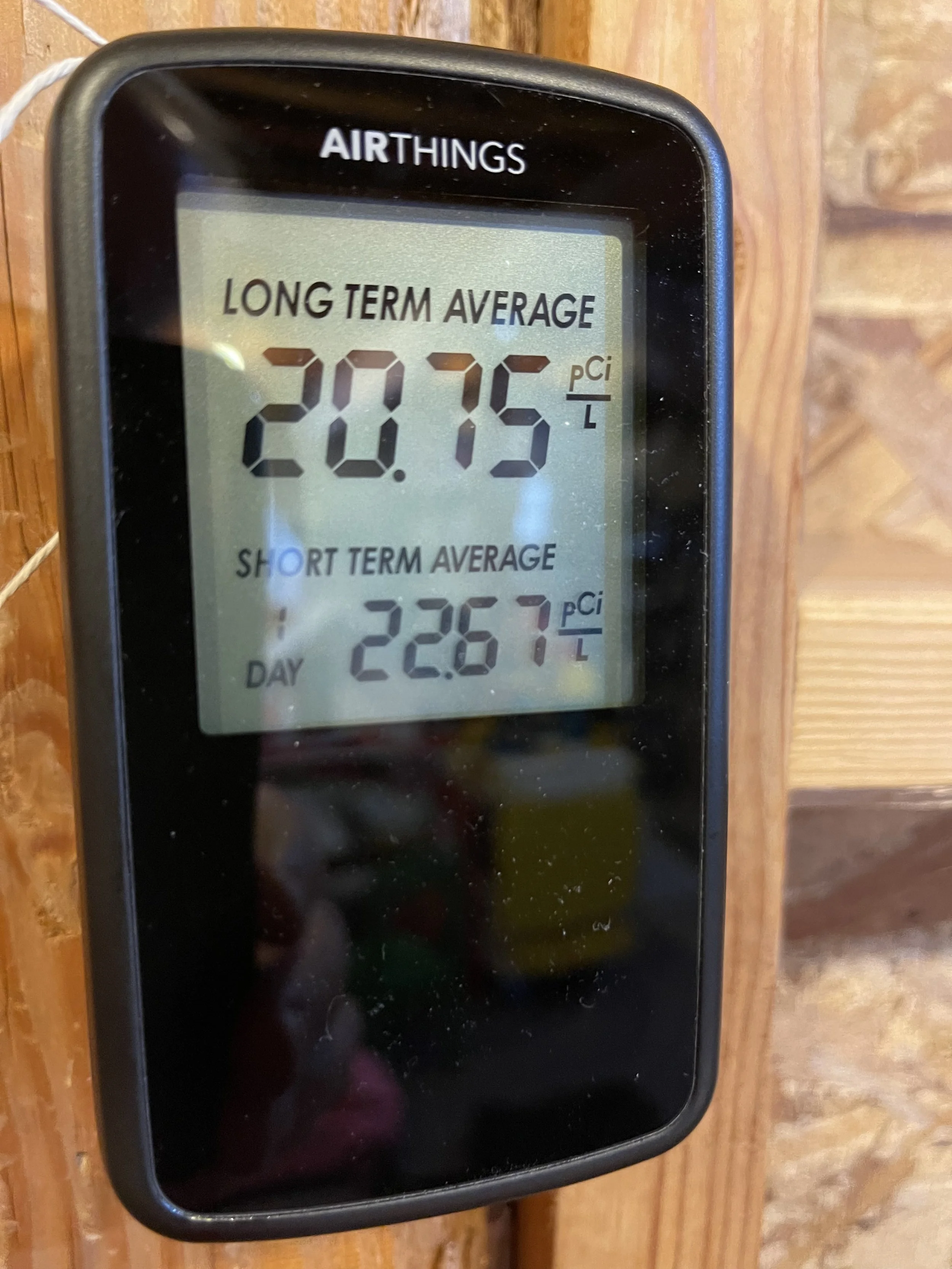
Not a Good Number!
2nd—Why Should We Care?
To begin with, I wish I didn’t care! There are many things in life we pass on because they may not affect us directly. That is common. But in this instance, it hit our family hard.
I guess I always suspected a problem, but I did not know how great it would be. I obtained an electronic tester because I wanted to see how radon levels varied over longer periods and across different seasons. Notice the picture of the results after a couple of weeks. And even worse, I discovered it rises more in the winter because, as the ground freezes, it pushes more radon into the warmer areas beneath homes. It reached 24 pCi/L. That is the equivalent cancer risk of smoking 2 ½ packs a day. After remediation, it is now 1.5 pCi/L!
But here is our burden. We have lived in our home for nearly 40 years. All that time, this silent, evil, menacing monster has been doing its work. In early 2026, my beautiful, perfectly healthy (non-smoking) wife of 65 years old was diagnosed with lung cancer. I am still in shock, and I blame myself for not learning more and getting on this beast earlier.
So, please may our burden help relieve you of a painful burden. Diane and I intend not to let this go. We are going to be in our communities’ faces about this issue. Testing and remediation are so cheap compared to what it costs in money, time, health, and happiness to be diagnosed with this horrible disease. I know…
In our journey of love, we worked so hard to build our home. We put our whole hearts into it and did everything ourselves. Together, we created a house, but Diane made it a warm and safe home. She is my joy, our family’s light, and her spirit is found everywhere. We cannot allow her to leave this living home and family. And Radon, our hidden scoundrel, is gone. I may be late, but I learned how to evict this sly demon, rising from his depths of hell, for good. This story is why we care. May we all work together to 86 this 86th element.
Please join me as I take on radon!

3rd—Are We in a High Risk Area?
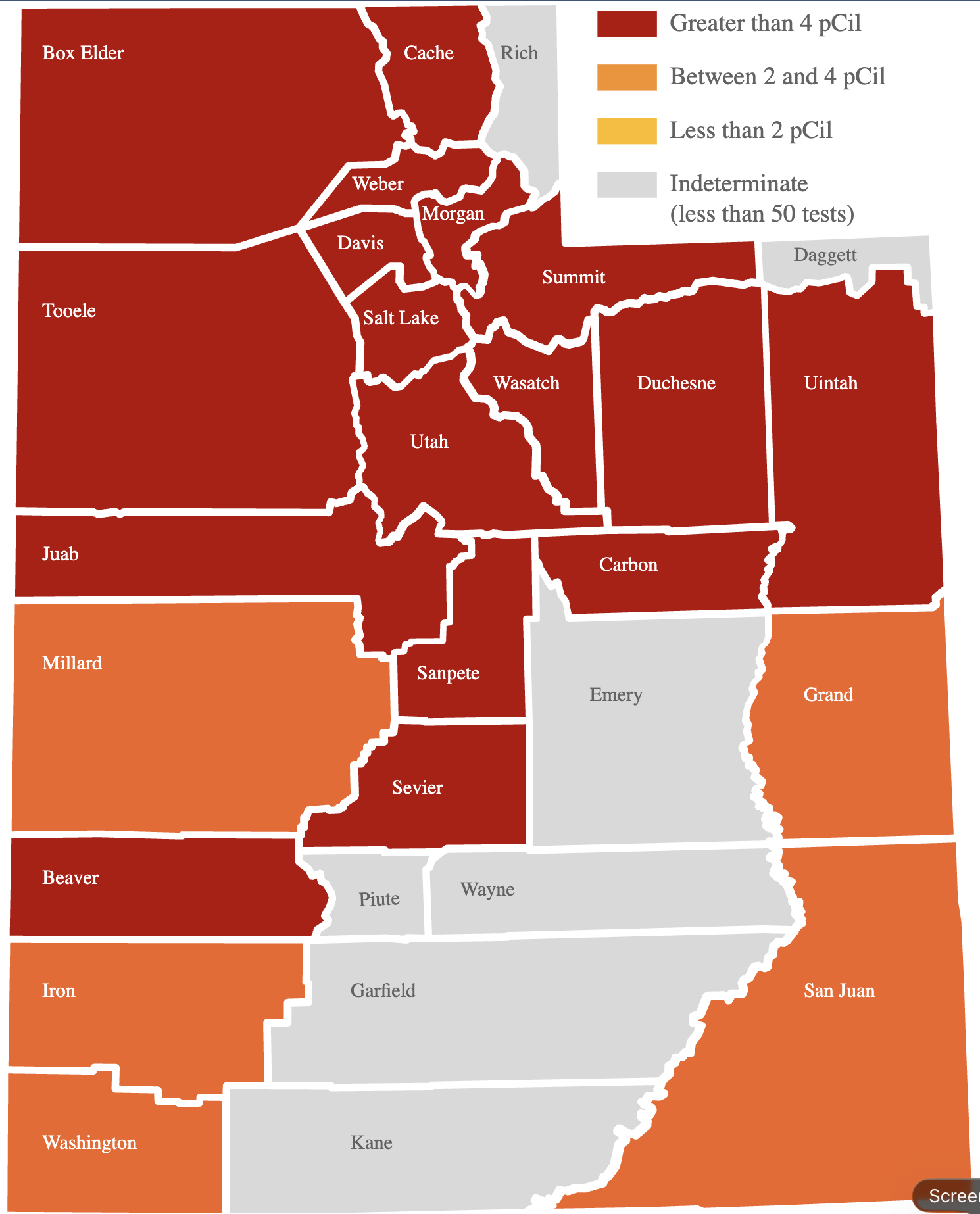
Start by determining if you are in a higher-risk area. In Utah, as many as 30% of all homes have dangerously high levels of Radon. Where I live, in Summit County, it is even higher. And the Park City area and Kamas Valley are the highest at risk. See the map below for county radon risks:
4th—When is it Best to Test?
The CDC (Centers for Disease Control and Prevention) recommends testing your home for radon in these situations:
Your home has never been tested, or radon levels are unknown (especially if you live in a higher risk area)
You're preparing to buy or sell a home
Before and after any renovations, especially foundation or ventilation work
After installing a radon mitigation system (to verify it's working)
Before converting a basement or lower level into living space (bedroom, office, playroom)
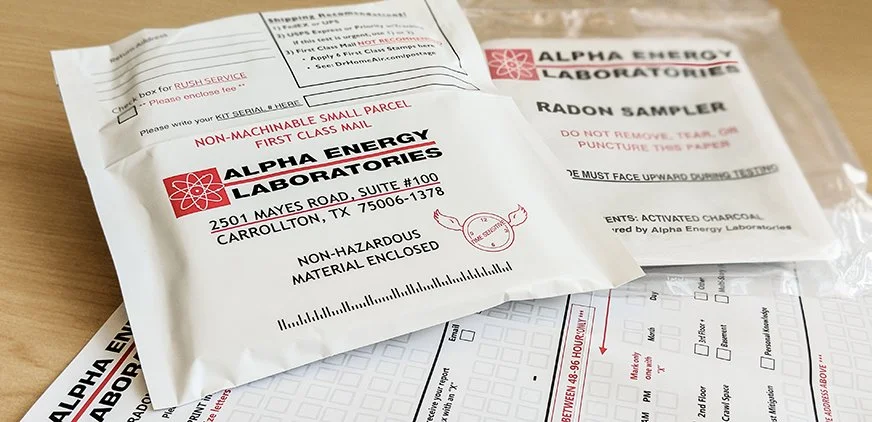
The best time of year to test:
It’s best to test your home during the colder months (late fall through early spring), when homes are sealed tight with windows and doors closed, since radon levels typically peak then. This is also the period when the ground may be frozen, and radon may migrate more readily into warmer structures, such as home foundations. Radon levels can be 50% or more higher in the winter months than in the summer.
For the most accurate picture of your home's year-round exposure, conduct a second test during warmer months as well.
5th—What Method Should I Use to Test?
Choose a short-term test (48 hours to 90 days) if:
You're buying or selling a home and need quick results.
You want an initial screening before investing in long-term monitoring.
You're testing multiple rooms to identify problem areas.
Choose a long-term test (90+ days) if:
You want to understand your home's year-round average radon level.
You're deciding whether mitigation is necessary.
You've already completed short-term testing and want confirmation.
Choose a digital continuous monitor (My preferred choice) if:
You want ongoing awareness of radon levels (short and long-term).
You're tracking the effectiveness of mitigation systems.
You value the ability to test multiple locations over time.
You want to monitor how lifestyle changes affect radon levels.
You want to share a tester with your friends.
Where can I purchase a radon test kit?
Begin by checking with your local health department.
Eurofins offers discounted test kits for Utah residents.
UtahRadon.org offers a free test kit through Utah Radon Services.
Airthings offers one of the most economical and reliable continuous detectors.
Amazon also offers a large selection of continuous radon detectors.
Where should I place my radon monitor?
In terms of location, select a room on the lowest level of your home where people regularly spend time (e.g., family room, office, or bedroom). If you live in an apartment or condo, place the detector in the bedroom.
Place the radon testing device on a flat surface (approximately two to three feet above the floor), such as a desk, table, bookcase, or shelf, away from drafts, including heating or air-conditioning vents. For a continuous digital radon monitor, be sure to place it in a room with relative humidity below 85%, as higher humidity can damage the radon sensor.
Then leave undisturbed during the testing period - do not move it to another location until testing is complete.
6th—What Do My Test Results Mean?
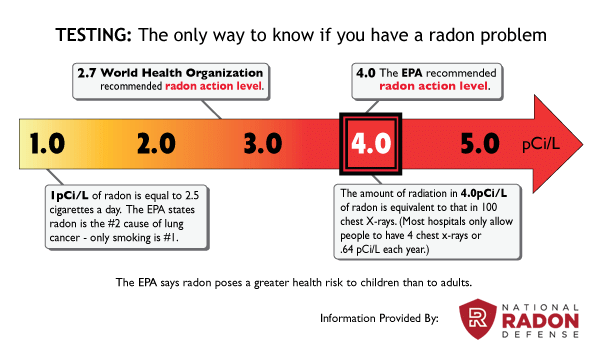
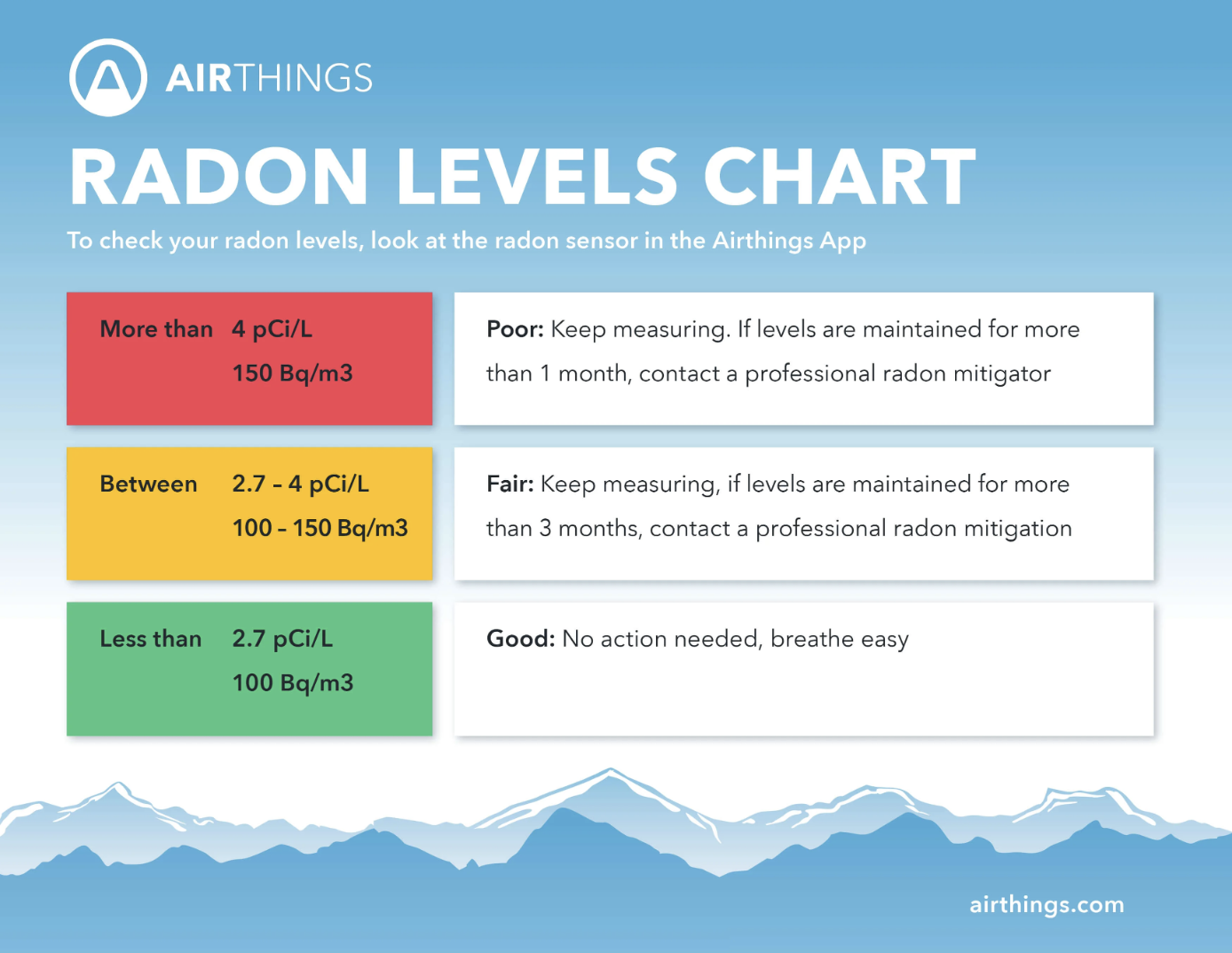
The two charts above show the radon action levels. The World Health Organization (WHO) sets an action level of 2.7 pCi/L, while the EPA action level is 4.0 pCi/L. If you maintain a long-term level (90+ days) between these two action points, you should seriously consider radon mitigation. Also, please remember that radon poses a higher risk to children than adults. The risk is also substantially higher if you smoke.
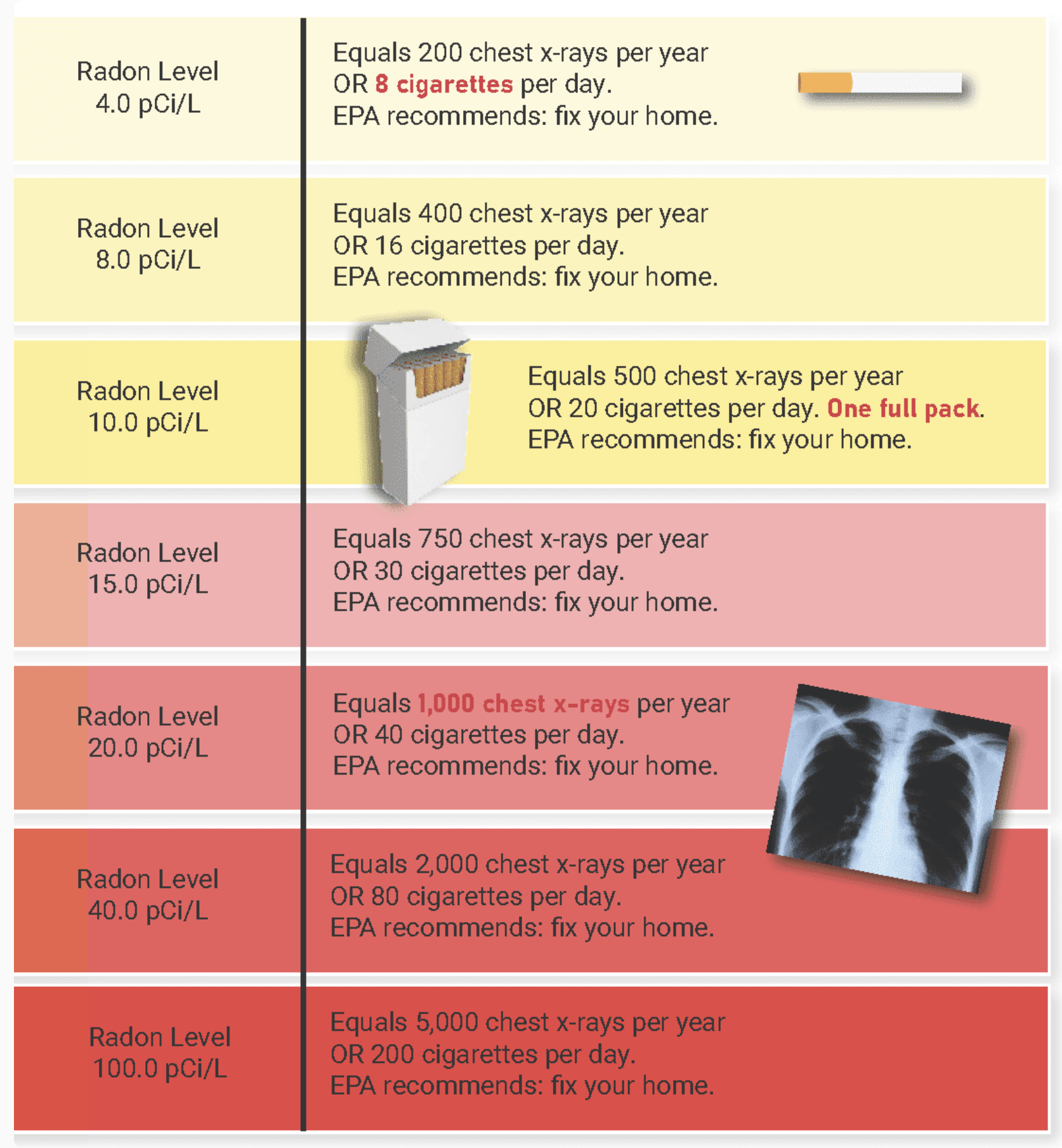
This chart is a bit frightening as it clearly shows the equivalent cancer risks of radon levels compared to cigarette smoking and chest x-rays.
But why do radon levels change?
If you're monitoring radon with a digital detector, you've probably noticed that your readings change, sometimes dramatically, from hour to hour and day to day. This is completely normal. Understanding why radon levels fluctuate helps you interpret your readings correctly. The amount of radon gas emitted from the ground and the amount of radon gas particles that actually enter a home can change for many reasons.
Short-term radon fluctuations:
Weather and atmospheric pressure: Falling barometric pressure (before storms) draws more radon into your home, as does rising pressure (sunny, clear days), which reduces radon infiltration. Radon often spikes 12-24 hours before storms.
Temperature differences: Cold outdoor temperatures create a stronger "stack effect" (warm air rising, pulling radon up from the soil). Hot summer days can reduce pressure differentials and radon entry. This is one reason why winter radon levels are typically 2-3x higher than summer levels.
Wind conditions: Strong winds create pressure variations around your foundation. Wind direction also affects which side of your home has lower pressure. Gusty weather can cause rapid fluctuations in radon levels.
Home ventilation: Opening windows drops radon levels within 1-2 hours. Running exhaust fans with windows closed pulls air (including radon) up from the soil. HVAC operation affects air pressure and radon entry. Closing up the house for winter also raises levels.
Seasonal radon fluctuations:
Winter (December-February) HIGHEST LEVELS: Homes are sealed tight against the cold, and with windows and doors closed for months, radon levels rise. Heating systems can also create negative pressure. Snow cover and frozen ground also prevent radon from escaping the soil surface.
Spring/Fall (Transition seasons) MODERATE LEVELS: Partial ventilation, as the weather warms/cools, and intermittent window opening help reduce levels.
Summer (June-August) LOWEST LEVELS: Radon levels typically drop with frequent window opening. Air conditioning creates different pressure dynamics, and warmer soil allows more radon to escape outdoors.
In short, every home will have some level of radon, but readings will be higher in the colder months. This is why the EPA recommends testing during the heating season (October-April), as winter tests will reveal your worst-case exposure. If your winter test is below 4 pCi/L, you can be confident your year-round average is safe.
Long-term radon changes (year-to-year):
Foundation settling: New cracks naturally develop as homes age, and existing cracks widen from ground movement. Basement waterproofing can help redirect radon entry points.
Landscaping and drainage changes: New landscaping that alters water flows can affect radon flows, including modifications to downspouts or surface drainage. Watch for soil erosion or settlement near the foundation and take a long-term test.
Home renovations: Basement finishing alters air pressure and ventilation, including new or updated HVAC systems, which change pressure dynamics. Again, foundation repairs may seal some cracks but leave other entry points more open.
Soil moisture variations and climate change: Drought (especially long-term) conditions allow more radon to be released from dry soils. Heavy rainfall can temporarily suppress radon (as water fills soil pores). Long-term moisture patterns shift over the years, and monitoring is important.
Nearby construction or geological events: Nearby construction vibrations can create new foundation cracks as excavations change soil pressure patterns and dynamics. Earthquakes (even minor ones) can also alter foundation integrity or shift some soils, facilitating radon escape.
What this means for monitoring:
Focus on averages, not spikes: Digital radon monitors show hour-to-hour fluctuations, but these momentary spikes aren't cause for alarm. What matters is your 7-day, 30-day, and annual average readings.
Test for at least 30 days: Short-term tests (48 hours) can miss important patterns. Allow your radon detector to measure for at least one full month to capture normal fluctuations and get a reliable average.
Retest annually: Because long-term changes can occur, retest your home once per year, preferably during winter when levels are highest. This ensures you catch any increases before they become health hazards.
Monitor after changes: Whenever you make significant changes to your home (renovations, HVAC upgrades, foundation repairs), retest radon levels for 30 days to see how they are affected.
7th—If High, What Can We Do to Reduce the Risk?
Begin by Sealing
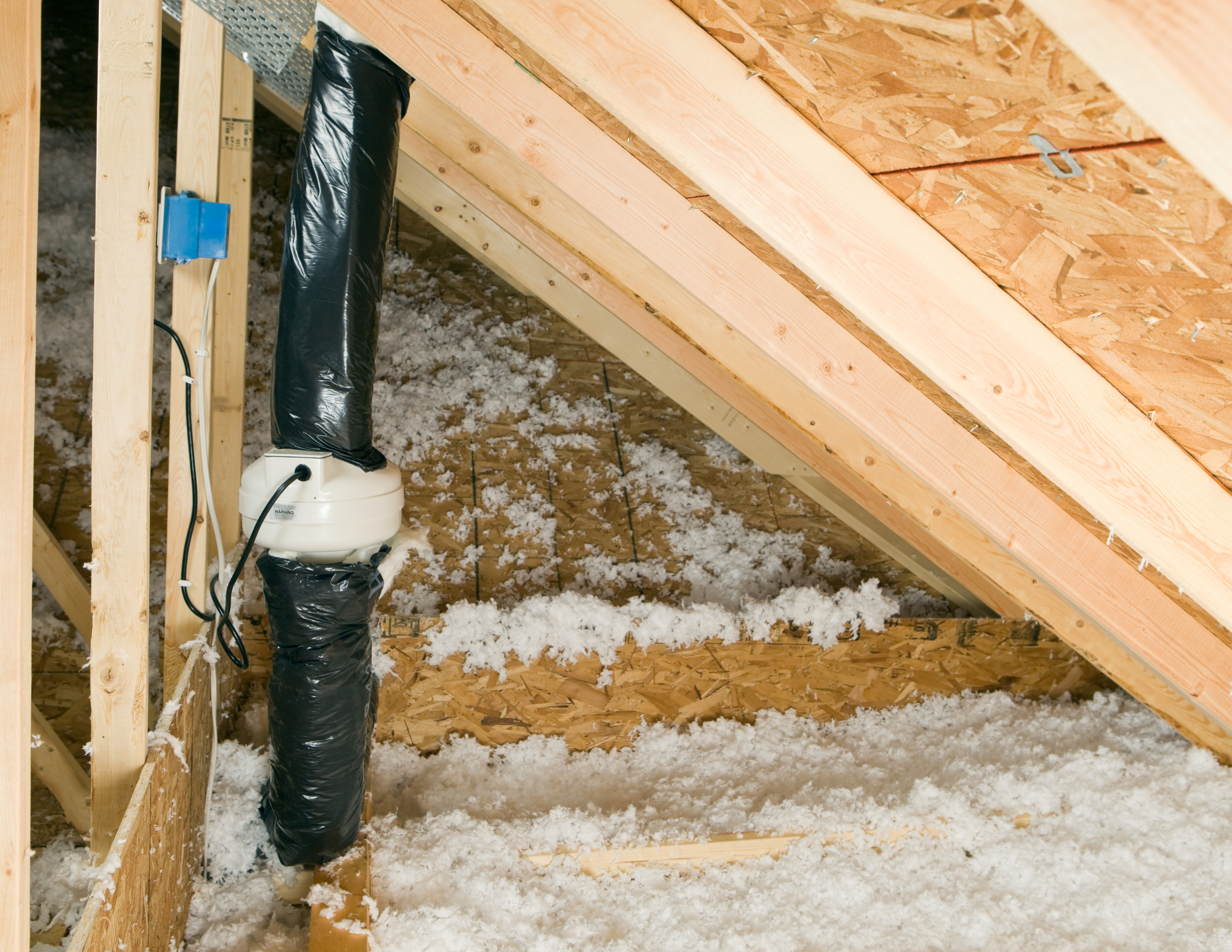
Sealing foundations to reduce radon involves creating an airtight barrier over cracks, joints, and utility penetrations in concrete floors and walls using polyurethane caulk and specialized sealants. Key areas include the floor-to-wall joint, sump pits, and visible cracks, which stop radon from entering and improve the efficiency of passive or active mitigation systems. For many, this can be a project you can undertake yourself, saving some costs. It may not be a standalone solution; however, sealing should be used in conjunction with active sub-slab depressurization (fan-powered systems) for maximum effectiveness.
Key Sealing Areas & Techniques:
Foundation Cracks & Joints: Use polyurethane caulk or concrete sealants to fill all cracks, expansion joints, and the "cove joint" (where the floor meets the wall).
Sump Pump Pit: Install an airtight, gasketed lid on the sump lid.
Utility Penetrations: Seal gaps around pipes, wires, and cables entering through the foundation with sealant or expanding foam.
Concrete Porosity: Apply specialized, deep-penetrating, water-based sealers (e.g., silane siloxane, or silicate-based) to porous concrete block walls or floors to block radon seepage.
Expanding Foam: Use for larger voids and gaps.
Plastic Sheeting (6 mil poly): For covering dirt floors in crawlspaces. This can also protect the home from moisture and mold.
Sump Pumps:
If you have high radon and a sump pump to mitigate high water levels in your basement or crawlspace, inform your radon mitigation company. There are several ways to modify and seal the sump pit, making it an effective means of using a fan to depressurize your sub-slab.
Utah Radon Mitigation Companies:
These professionals deal with this issue every day. Remember, it is important to get bids if possible. Certification can be checked by selecting the buttons to the right. NOTE: These contractors are not ranked in any particular order.
Utah Radon Services(RadonResolved): Offers 48-hour testing and customized, active mitigation systems with a transferable lifetime warranty.
Wasatch Radon: Specializes in residential mitigation and new construction, targeting levels below 2.7 pCi/L.
Radon Be Gone: Since 2008, providing residential and commercial mitigation throughout Utah.
Precision Radon Services: Certified by AARST-NRPP, providing free tests and lifetime labor warranties.
Homaera Radon Solutions: Focuses on Northern Utah (Salt Lake City, Park City, Provo) with data-driven testing and mitigation.
Utah Radon Defense: Serves Orem and South Jordan with certified specialists and low-level guarantees.
Protect Environmental: Specializes in high-level radon and vapor intrusion, including for commercial sites.
RadonTek: Focuses on custom, high-quality, and fast-turnaround mitigation systems.
What does radon mitigation cost?
Radon mitigation costs typically range from $800 to $2,500 for a professionally installed system. These estimates can increase if more than one ventilating unit is required or if you have a crawl space that requires a new membrane system. However, catching high radon levels early through testing can prevent lung cancer and save lives, making any testing investment worthwhile.
The EPA estimates that radon causes 21,000 lung cancer deaths annually in the United States. With that in mind, investing in reliable radon testing and mitigation provides invaluable peace of mind and protection for your family's health.
8th—Are Their Other Resources to Guide Us?
An incredible resource for Utah! And get a free radon test kit.
Utah Department of Environmental Quality, Division of Radiation Control.
EPA has many radon resources and science links.
Learn more about the risks in the Utah area and the geological origins and physics of radon.
This offers the best guidance and information library, with links to many scientific studies.
Valuable testing information with cancer risks and resources.
A wealth of information is provided by the University of Utah’s Radon Lab.
Important Advice: It costs virtually nothing to include radon remediation in your new construction. Please press your local municipality to adopt Appendix F of the IRC Building Code to ensure new homes are ready to address potential radon issues. This action will definitely save lives!
Also, take time to learn the facts about radon issues related to real estate transfers. There is a lot of misinformation regarding this important issue.
The details and the economy of installing passive radon remediation systems in new construction.
Why do we and Real Estate professionals need to learn more about radon? Here is why.
9th—Should I Share the Word With My Friends?
YES — Sharing potential life-saving information, such as radon education, safety, and remediation stories, is crucial because it not only improves the lives of our families, friends, and neighbors but also our entire community. And if you own an electronic tester, share it! But as you do so, remember to be kind, don't speak in a threatening or fearful tone. This can be counterproductive. How we spread the word is a direct reflection of how we extend our love. God bless you all, my friends!

10th — Enjoy Peace
There is one place we go
Where time grows ever slow
Below—twisting branches free
In cool shades of our family tree
D.W. Evans